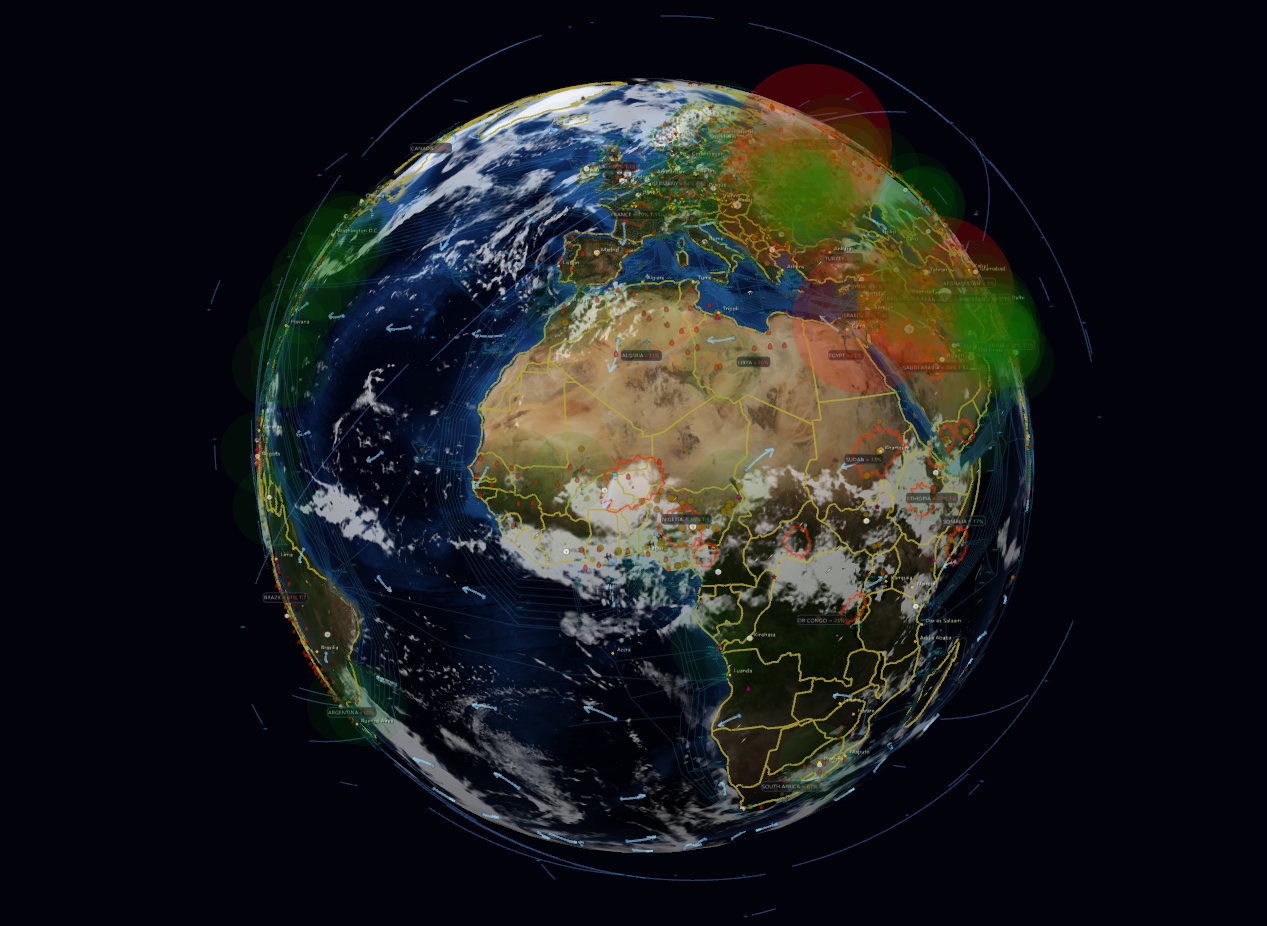
Meridian fuses aviation, maritime, conflict, environmental, and news intelligence
into a single real-time 3D view. The meta-system beneath it learns from every
event it sees, adapting thresholds, source weights, and severity formulas per region
until predictions become genuinely accurate for the world as it is now.

3D Interactive Globe
Satellite imagery tiles, smooth camera orbit, zoom from full globe to
1.5-degree telephoto FOV. Cockpit first-person view mode for immersive
monitoring. Clean mode for data-focused analysis. Day/night terminator
with real-time sun position. Cloud overlay layer. Milky Way skybox with
Moon rendering. Smart icon clustering that never hides military aircraft.
Cinematic auto-pan mode for presentations. Conflict heatmap overlay.
Missile impact animations with separate ballistic and cruise trajectories.
Tsunami wave animations. Manual map markers with persistent storage.
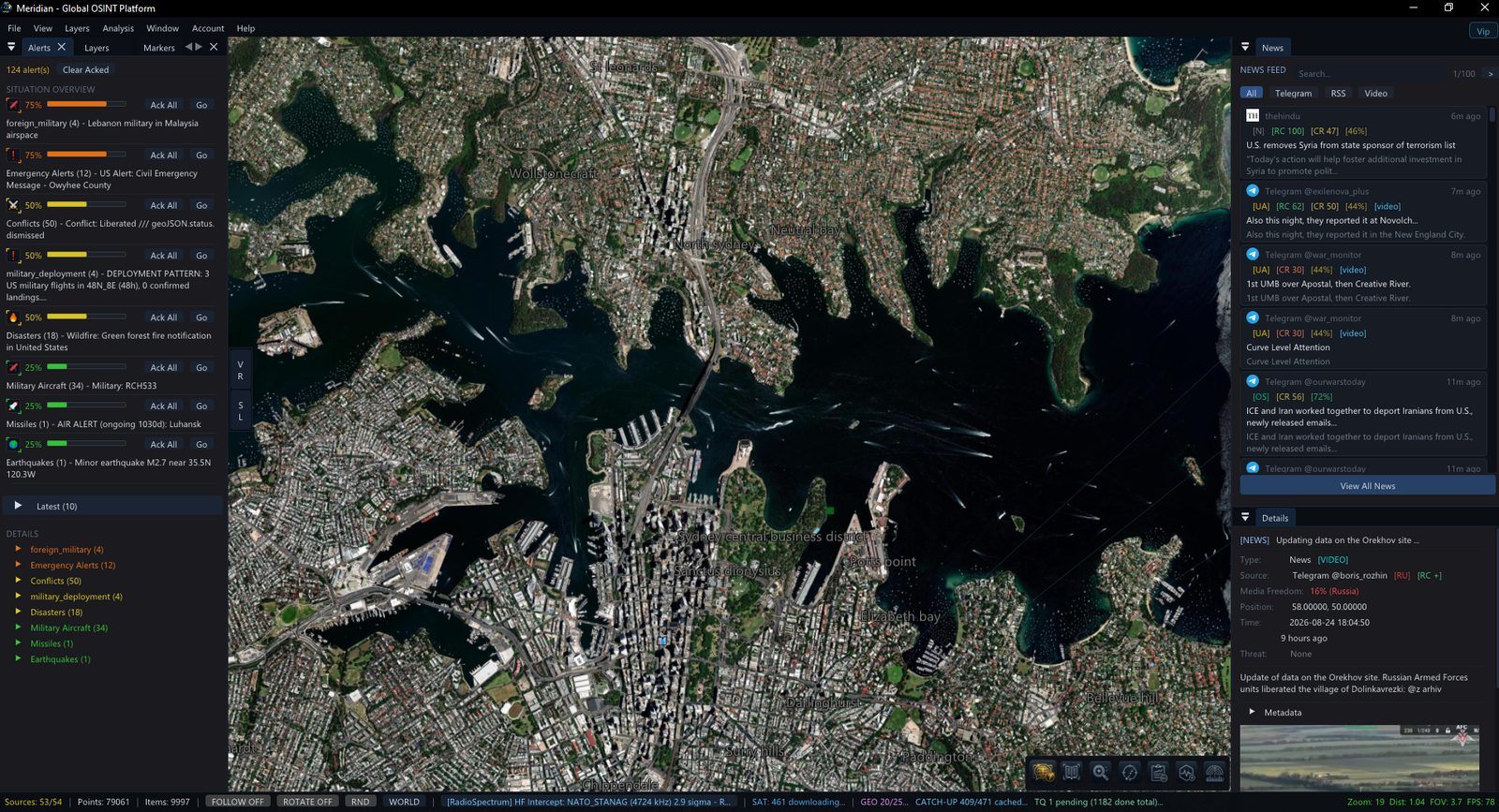
Zoomed to Sydney Harbour at street level, with individual AIS vessels visible in the water.
~
54 Live Data Sources with Multi-Source Corroboration
ADS-B aircraft tracking across 5 independent feeds with cross-source
corroboration to validate military activity. AIS ship tracking via WebSocket.
RSS news across 34+ feeds including CGTN, RT, and Xinhua for comparative
narrative analysis alongside Western outlets. Telegram OSINT channels,
Reddit, earthquake/seismic, NASA FIRMS fire detection, GDACS disaster
alerts, conflict zones, weather/wind, lightning, air quality, submarine
cables, BGP route monitoring, and IoT sensor networks. Every source
weighted by region-specific reliability scores that the system learns
over time.
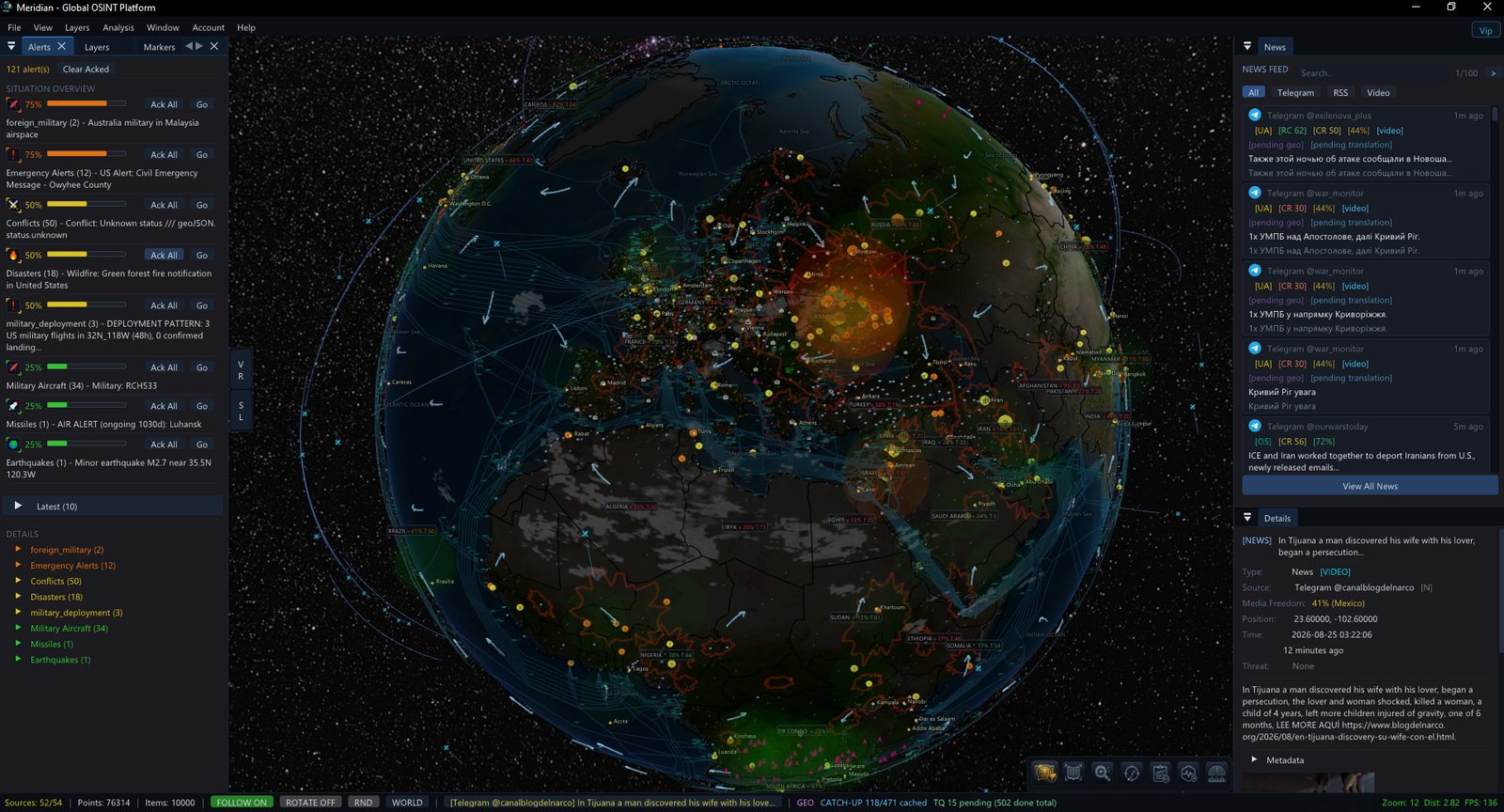
121 active alerts, 76,000 live data points, running at 136 FPS.
!
Multi-Factor Threat Scoring
Every event classified by severity, magnitude, proximity to critical infrastructure,
and regional density. Four-weight scoring engine outputs
None/Low/Medium/High/Critical threat levels with configurable thresholds.
>
Intelligence Fusion and Cable Security
GPS jamming-to-attack correlation predicts strikes before they happen.
Cable sabotage detection: ship-cable loitering flags vessels stationary
within 1km of a cable for 30+ minutes, 20+km offshore, combined with
AIS-dark detection and news mention correlation for three-layer verification.
Civilian air avoidance detection - a sustained drop in civilian flights
over a region (below its learned per-hour baseline) fires as an early
warning signal, because crews reroute around active closures and hazards
before any official report. Per-country tension index from five signal
types. 45+ conflict zones auto-updated from Wikipedia. LLM threat vector
extraction reads articles, identifies origin and target locations, and
renders directional arrows on the globe. Conflict intensity heatmap overlay.
Kinetic-context-aware predictions: the system does not generate missile
predictions in regions with no relevant history.
@
AI-Powered Analysis and Reality Check
Six independent AI pipelines: geolocation, threat analysis, SITREP,
news summary, translation, and pattern synthesis. Each can be assigned
a different LLM provider independently: local Qwen 4B, DeepSeek R1
7B (reasoning), Claude API, or any OpenAI-compatible endpoint. Foreign-language
sources - Arabic, Russian, Ukrainian, Spanish, French, and more - are
auto-translated as they come in, with detection smart enough to skip
content that's already in English so nothing gets double-translated.
Per-article LLM tension scoring assigns each news item a 0-100 severity score stored
in SQLite, so the system accumulates institutional memory rather than
re-scoring on every run. News reader in newspaper mode with full-screen
article popups and sort by intelligence priority. Reality Check pipeline
performs adversarial LLM fact-checking with per-source credibility scoring
(0-100). Narrative Analysis compares Western, Russian, and Chinese framing
of the same events. LLM judge grades the system's own predictions so
accuracy improves automatically.
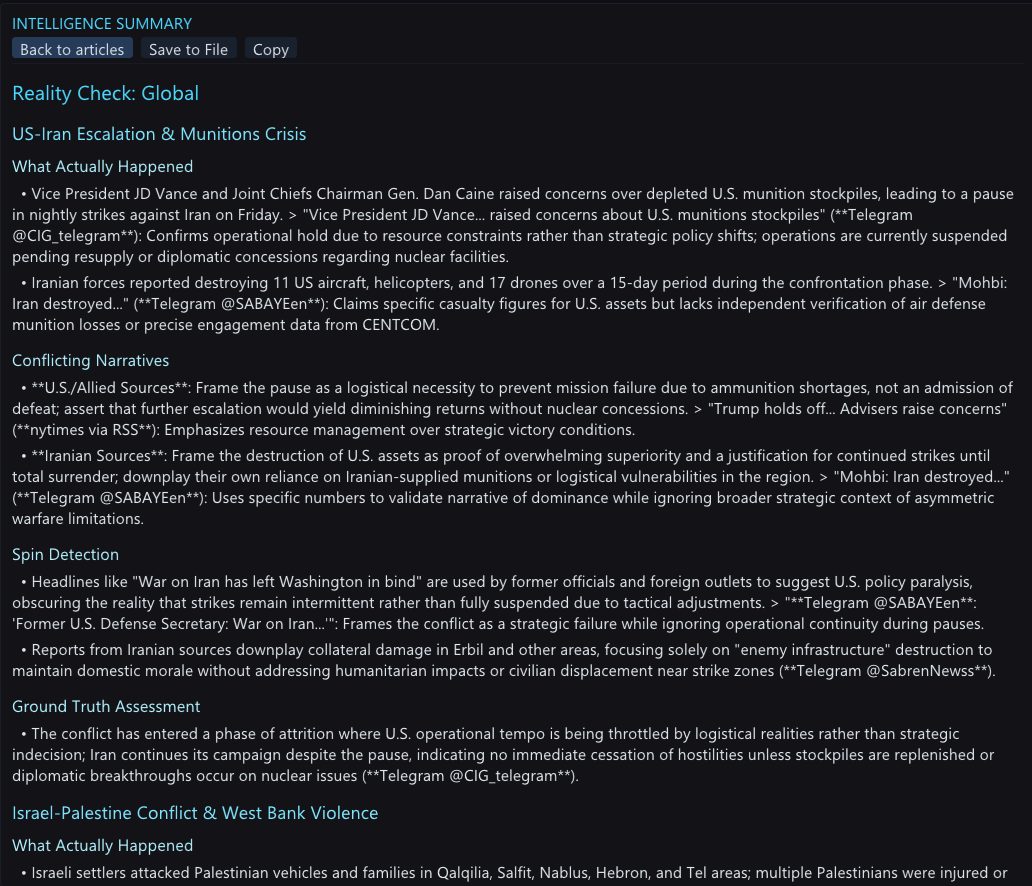
Reality Check output: verified facts, conflicting narratives, spin detection, ground truth assessment.
%
Democracy Barometer
Every country scored 0-100 from five international indices (Freedom House, EIU,
V-Dem, RSF, Transparency International). Trend arrows show 10-15 year trajectory.
Click any country for full breakdown, tension score, and geopolitical context.
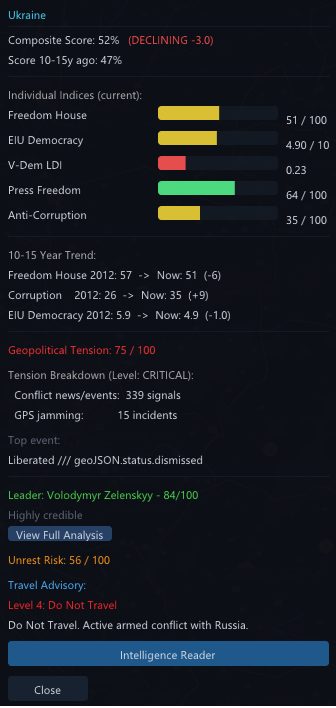
Country popup: democracy indices, 10 to 15 year trends, tension breakdown, leader credibility.
⚠
Global Emergency Alerts
Five country-specific military alert systems integrated directly: Israel
(Pikud HaOref real-time rocket alerts), Japan (J-Alert missile warnings),
South Korea civil defense, Taiwan NCDR, and Canada Alert Ready. Plus FEMA
IPAWS for the US and CAP/MeteoAlarm aggregating 30+ European countries via
WMO. Two independent Ukraine air raid alert feeds run simultaneously.
NOAA tsunami warnings, IAEA nuclear events, WHO/ProMED disease outbreaks,
internet outage detection (IODA + Cloudflare), BGP route change monitoring
for cable/shutdown detection, maritime piracy reports, and travel advisories.
CAP/MeteoAlarm filtering keeps only high-value civil-protection warnings -
earthquakes, floods, wildfires, tornadoes, hurricanes - rather than flooding
the globe with the routine severe-weather advisories that would otherwise
blanket entire countries. All color-coded by severity and plotted on the
globe within seconds of broadcast.
◆
Sanctions & Geopolitical Context
Real-time sanctions tracking (OFAC + EU) for 22+ countries and entities.
Comprehensive geopolitical context for 30+ nations: alliances, adversaries,
bloc affiliations, strategic capabilities. Country popups show sanctions
status, alliance networks, and neighbor tension scores. Travel advisory
integration from the US State Department displayed alongside country risk.
◉
Live Webcam Network and Visual Recon
Global webcam integration with hotspot-based discovery prioritized around
conflict zones. Click any webcam icon on the globe to open a live view
directly in the detail panel. Visual reconnaissance tool: pin any location
on the globe, query nearby webcams, and auto-composite their images into
a single reference snapshot for the area. Persistent cache ensures fast
loading across sessions.
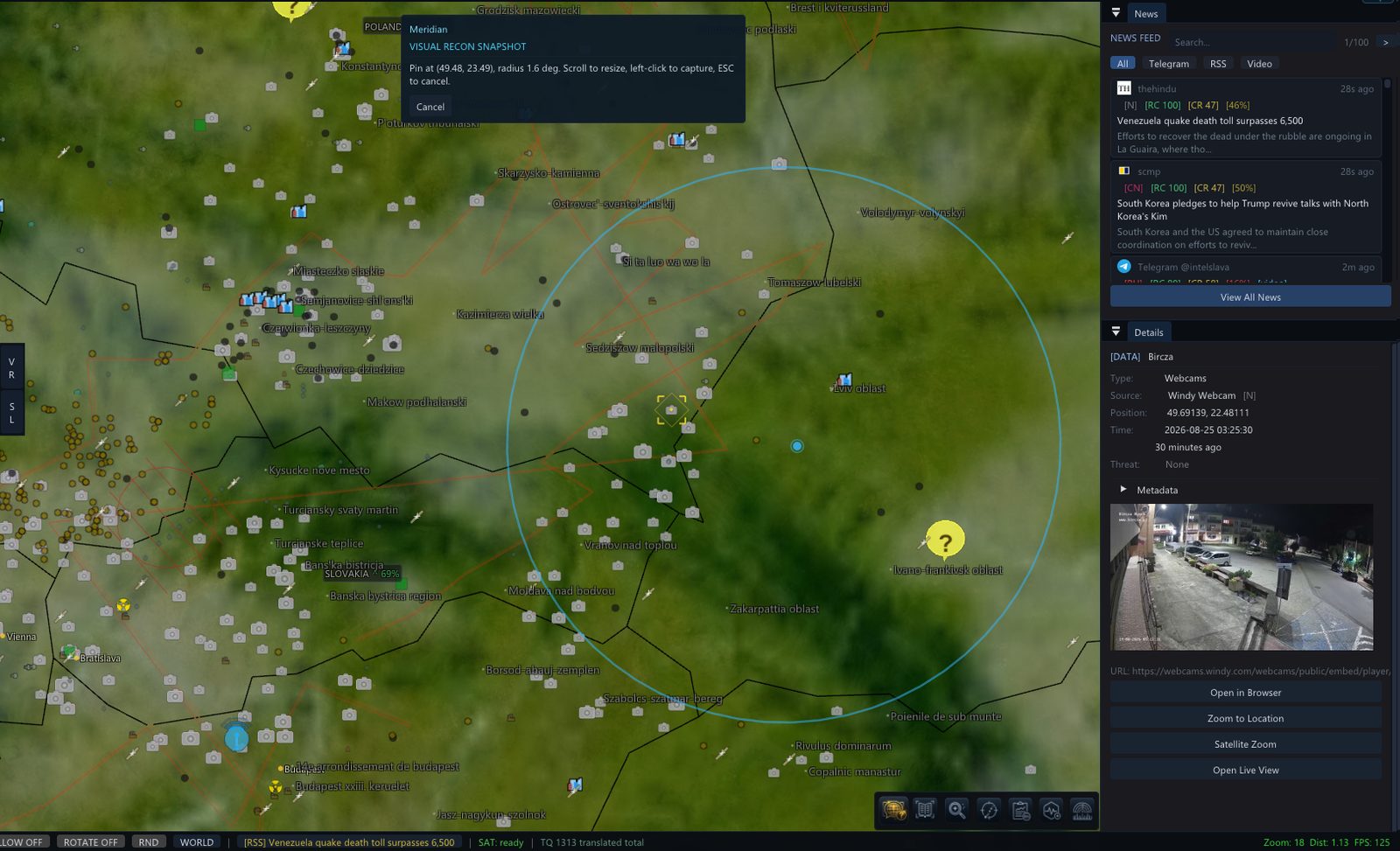
Visual recon snapshot tool, selecting a radius to capture every webcam inside it.
♦
Leader Profiling
AI-powered behavioral profiles of world leaders built from accumulated
news analysis. Tracks promises vs outcomes, logs contradictions with
dates and quotes, monitors rhetorical patterns, and scores credibility
(0-100). Profiles evolve over time as new articles are processed -
the system builds institutional memory.
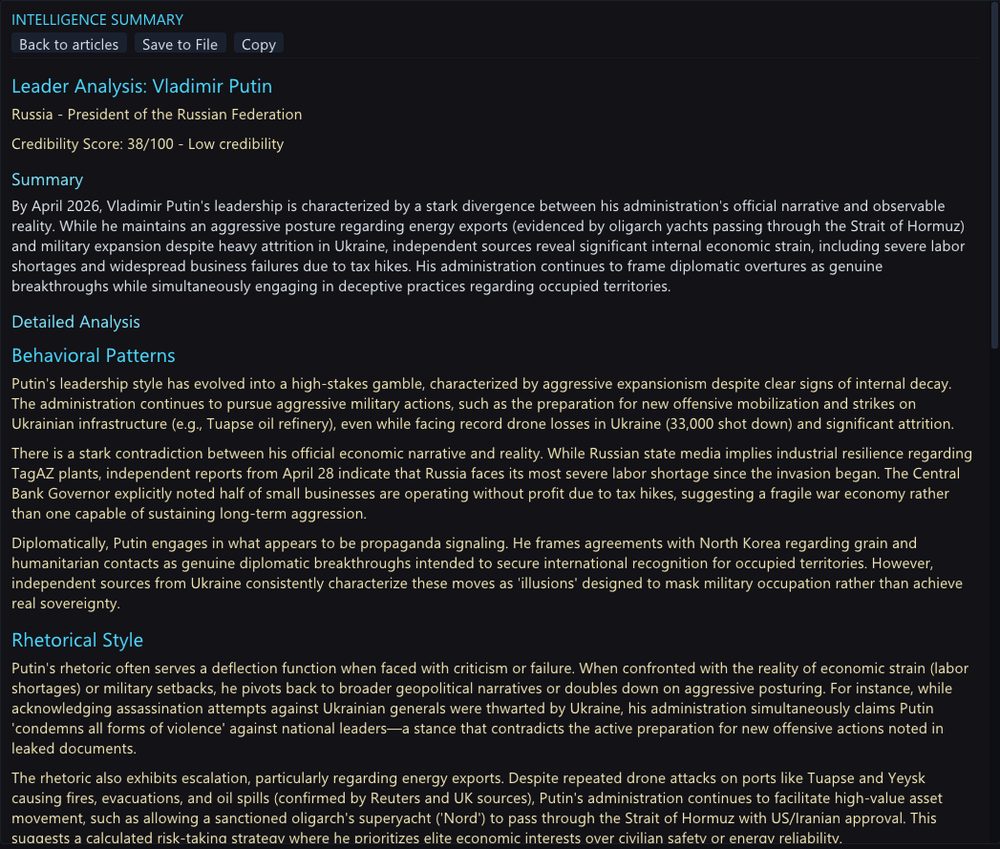
Leader analysis with credibility score, behavioural patterns and rhetorical style.
◀
Multi-Mode Search Widget
Six search modes in one widget: Location (city/country with globe pan),
Planes (callsign or flight ID), Ships (MMSI or vessel name), Energy
(power plant name), Datacenters, and All Entities. Type-ahead suggestions
populated from live data. Covers the entire tracked dataset - if it's on
the globe, you can find it by name.
■
DeepState Occupied Territory Mapping
Live-updated occupied and contested territory polygons from the DeepState
mapping project, synced directly from their public GitHub repository.
Overlaid on the globe as a toggleable layer. Updates automatically as the
frontline changes, without any manual intervention.
■
Self-Learning META System
The Pattern Discovery Engine divides the world into 2x2 degree cells and learns
per-cell baselines using Welford's algorithm with 24 separate time buckets per
cell - one per hour of day - so the system knows that 3am quiet is different from
3pm quiet. Bayesian-weighted convergence scoring adapts over time. Seven scenario
templates (troop buildup, economic warfare, humanitarian crisis, and more) match
against live signal patterns. Predictive alerts from ~30 learned source-pair
conditional probabilities, composed into multi-step escalation chains (GPS jamming
into drone incursion into missile strike, for example) that forecast likely follow-on
events rather than isolated alerts - gated so a chain only fires when it has real
historical completion data behind it for that region. Self-grading prediction ledger:
an LLM judge evaluates each forecast after its time window expires. Hit/miss/partial/inconclusive
verdicts feed back into convergence thresholds that tighten or relax per region automatically.
Alert-firing thresholds self-tune the same way: when a gate's hit rate slips it tightens
to cut low-value alerts, and when accuracy has headroom it loosens back toward its
shipped default, with a visible audit trail of every adjustment. All learned data
decays weekly so the system adapts to changing conditions rather than freezing on
stale history.
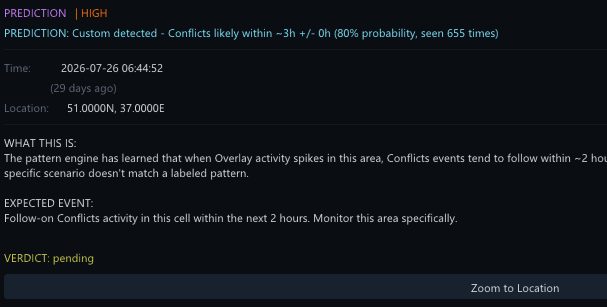
A learned correlation firing as a prediction: 80% probability, observed 655 times.
◆
HF Radio Spectrum / SIGINT Monitor
Passive monitoring of public KiwiSDR receivers worldwide on military HF bands:
NATO STANAG, USAF HFGCS primary and backup, Russian Navy and Military,
maritime distress, and aviation weather. Baseline-subtracted sigma scoring
flags unusual transmitter activity per station and band. Spikes above 2.5 sigma
generate alerts; above 4 sigma trigger High-threat classifications. HF
corroboration engine retroactively links high-sigma radio activity to conflict
events that occur within receiver range, building a per-cell correlation count.
When a conflict event fires in a cell with prior HF corroboration, its convergence
score is automatically boosted. Integrates into the main alert panel as "HF Radio
Spikes" and feeds the Pattern Engine as an additional convergence signal.
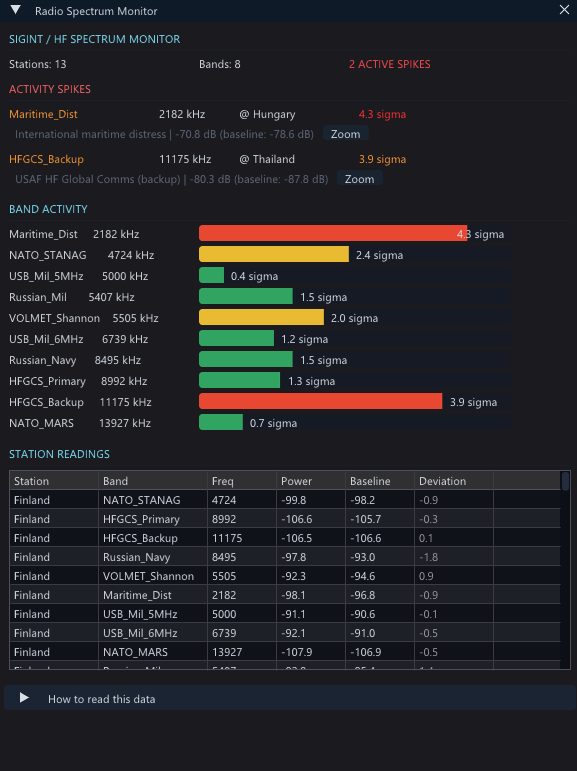
HF band activity against learned baselines, with sigma deviation per band.
▲
Military Intelligence
AirspaceMonitor uses polygon-based country detection against a full ICAO hex
database to identify military aircraft over any nation. Alliance and treaty map
(NATO, Five Eyes, CSTO, SCO, and more) with override JSON for custom
classifications. Tension-weighted severity scoring draws from a real tension
database. Military callsign detection runs across all five ADS-B sources
simultaneously. Deployment surge detection fires when military transport
activity in a region spikes above its rolling 7-day baseline.
◆
Economic-Conflict Intelligence
Financial market monitoring correlated against live intelligence signals.
Tracks key commodities (gold, WTI and Brent oil, natural gas, wheat, corn)
and defense equities (Lockheed Martin, RTX, Northrop Grumman, General
Dynamics, BAE Systems, Rheinmetall, Thales, Safran, Elbit Systems) via
Yahoo Finance. When commodities spike 2.5%+ alongside conflict signals in
linked regions, an Economic-Conflict correlation alert fires. Defense delta
analysis compares defense stocks against their country market index: a positive
delta in a high-tension region is a conflict premium signal; a spike without
accompanying escalation is a leading indicator. All market events appear on
the globe at their geographic nexus.
■
Prediction Scorecard
Real-time dashboard tracking every prediction the system has ever made.
Five overview counters: total, verified, hit rate, pending, and active regions.
Active predictions panel shows live countdowns with source type color-coding
(Anomaly, Convergence, Predictive, Template, Intel Estimate, Chain). Verdict
panel displays completed judgments (hit/miss/partial/inconclusive) with reason
text from the LLM judge. Regional accuracy breakdown table ranks every
region-metric pair by prediction volume and hit rate. Rolling accuracy trend
graph plots accuracy over the last 200 verdicts in a 10-verdict rolling window
so you can see if the system is improving or degrading over time.
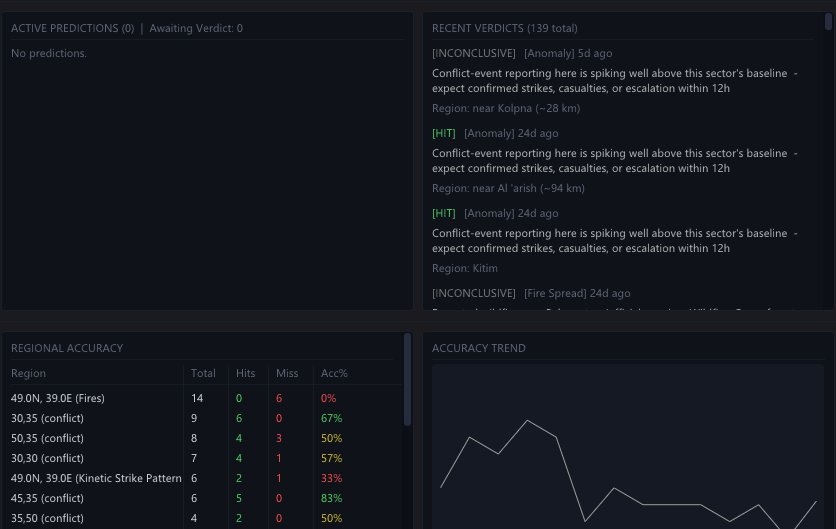
Every prediction graded against what actually happened, hits and misses alike.
●
Entity Tracking and Intelligence Tracker
Click any aircraft or ship to begin tracking it. The system logs every position
update as a timestamped waypoint with speed and heading data, draws a
color-coded trail on the globe, and flags "SIGNAL LOST" if the entity goes
dark. The Intelligence Tracker overlay opens a full-screen analysis workspace:
left panel lists all tracked entities with waypoint counts, right panel shows
entity details including registration, aircraft type, MMSI, squawk code,
OpenSky-derived departure airport, estimated destination, airline, and an
inline aircraft or ship photo. Route log scrolls the full position history
with reverse-geocoded place names at each waypoint. Tracked entities persist
across restarts.
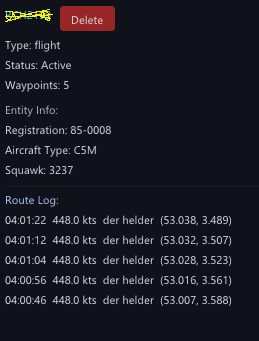
Tracked aircraft with registration, type, squawk and a timestamped route log.
▲
Source Health Dashboard
Live status panel for every data source in the platform. Shows connection
status (Connected, Connecting, Offline, Error, Rate Limited), total fetch
count, total items ingested, error count and error rate, time since last
successful fetch, and poll interval. Stale sources are highlighted in amber
when last fetch age exceeds three times their polling interval. Sources are
sorted by priority: errors first, then connected, then disabled. Lifetime
aggregate counters at the top give a quick health snapshot across all feeds.
■
Expanded Threat Classification (12 Types)
The LLM threat pipeline now classifies articles into 12 threat types. Beyond
the original conflict, missile, drone, and none categories, the system now
detects: emergency (state of emergency, martial law), terrorism, nuclear
incidents, cyberattacks, civil unrest, sabotage (infrastructure destruction),
maritime threats, airspace violations, and chemical/biological events. Each
type maps to the appropriate map layer. The Intelligence Reader displays a
distinct badge tag for every article: [WAR], [MSL], [DRN], [EMG], [TER],
[NUK], [CYB], [UNR], [SAB], [MAR], [AIR], [CHM].
▶
Quick-Access Analysis Toolbar
Six analysis tool icons in the status bar for instant one-click access to:
Intelligence Reader, Discoveries, Intelligence Tracker, Prediction Scorecard,
Source Health, and Radio Spectrum Monitor. No more digging through menus to
reach the tools you use most.
▼
Auto-Update System
Built-in update checker (Help - Check for Updates) shows your current version
alongside the latest available release. One-click download and install. Secure
token-based downloads verified through the license server.
■
Native File Save Dialogs
All report exports - SITREPs, reality checks, narrative analysis, and news
summaries - now open a native Windows file save dialog. Choose exactly where
each file lands instead of having reports silently dumped to a cache folder.
☎
Mobile Connect COMING SOON
Stream your Meridian desktop to an Android companion app and control
it from your phone. Two modes: lightweight 2D data view over mobile
data, or full HD rendered globe over WiFi. Pan, zoom, search, track
entities, and trigger AI analysis remotely. QR code pairing from the
desktop. End-to-end encrypted P2P tunnel between your devices. The
server only brokers the initial connection, then steps away. Your
data never touches our infrastructure.